I was delighted by the enthusiastic turnout for my presentation on the history of signs at the Petaluma Arts Center on May 19th. The follow-up emails I’ve received have been particularly rewarding—hearing from attendees who are now noticing and appreciating signs in entirely new ways.
For those who couldn’t attend, the presentation wasn’t recorded, but I’m working with Connie Williams at the Petaluma Regional Library to create a version for their YouTube channel within the next month. I’ll share that link through social media and directly with my blog subscribers once it’s available.
Until then, I’d like to highlight one of the “lost signs” that didn’t make it into the presentation: Drees Florist. The business relocated from 25 Western Avenue to the newly completed Drees building at 207 Western Avenue in 1942. The Petaluma Argus Courier reported on the new location on April 11, 1942:

“Alden “Pete” Drees and his mother, Mrs. Lucy Drees, have one of the most modern florist shops in the North Bay. The main shop is equipped with shelves for displaying gardening utensils and supplies, and there is a special built-in display rack for seeds. A feature is the large refrigerator for preserving the more perishable blooms.
Leading toward the back part of the shop is a potted plant display greenhouse. At the rear of this greenhouse is a tiled drip fountain, which will eventually be covered with ferns and moss. A small motor keeps water in the lower pool revolving for reuse in the fountain.
Adjoining the greenhouse is the floral piece and bouquet preparation department, equipped with ribbon, paper, and pin lockers and drawers and a handy sink and drainboard for watering flower containers.
At the rear and along the western side of the building is a small yard space used for nursing seedlings and displaying trayed plants. A side entrance opens onto the yard. An upstairs room is used to store stock and equipment.
The opening of the new store is another step in business out of Western Avenue, the first step being taken a number of years ago by food markets, then the building of the new Leader department store, and now Mrs. Drees’ new building housing Cline’s furniture and the florist shop.”
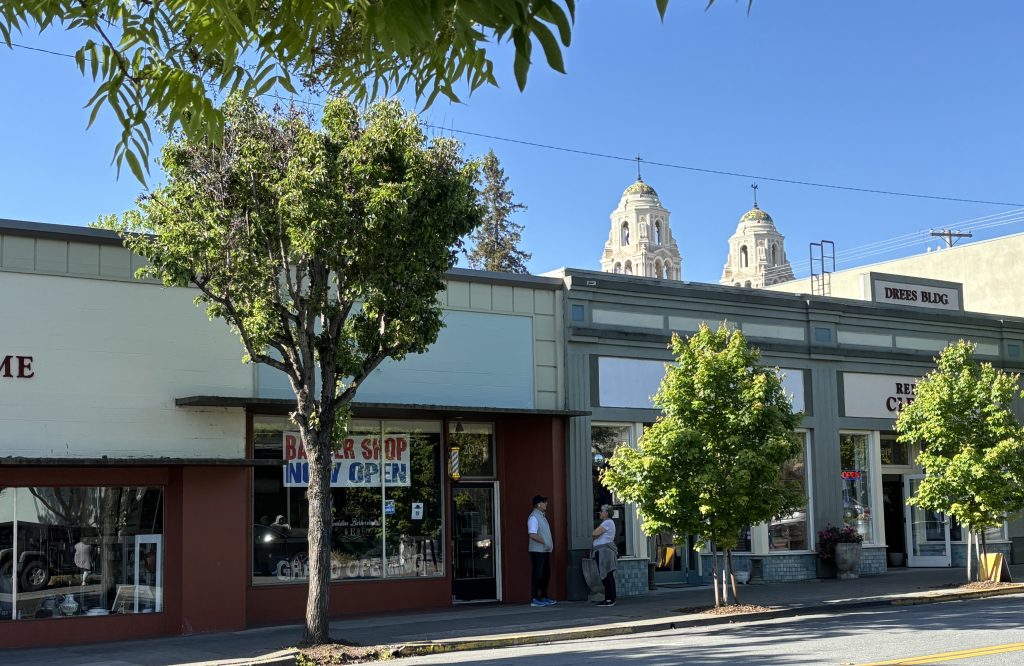
May 2025. Credit: KJR
First Hand Nail Salon occupied this location from 1992 until its recent closure, when Evolution Barbershop took over the space. While it may be unrealistic for the barbershop owner to install a new sign that matches the elegant design of the original Drees Florist sign, one can always hope. I understand the building is for sale, so this property’s use and appearance may change in the coming months.
Here’s an image of the entire structure as it appeared when completed. I’d love to find an early photograph of this classic Streamline Moderne-designed building, which featured some really cool signs, including not just the Drees Florist but the large redwood block-lettered word “Furniture” on both sides of the building, as well as a large white neon sign, “Cline’s,” located above the corner entrance. Umpqua Bank currently occupies Cline’s.

Feb. 2, 1942.
 Demolition is Not Historic Preservation
Another fascinating look at Petaluma’s past! It really draws a circle around the changing patterns of everyday life. There are no longer any florist shops, or furniture stores, but we do still buy flowers and need furniture. How and why did that happen, and what does it say about how our town needs to change to stay vibrant and alive? The past has a lot of guidance for the future!
Many thanks Katherine!
Great comments and observations! You’ve presented many ideas for future articles. For instance, one could focus on specific downtown stores that once provided Petalumans with most of their retail needs, transitioning to an era dominated by online shopping and big box stores like Costco. In 1947, Petaluma had five retail furniture stores (Cline’s, Guy’s Furniture Co., Stone’s, and Weller Hopkins) and three department stores (Carithers, formerly known as The Leader), along with Montgomery Ward & Company and J.C. Penney. Additionally, there were three florists: Drees, Rose E. Piezzi, who operated out of the Hotel Petaluma, and Weis Florist (later known as Chalet). In 1951, Sears-Roebuck opened a catalog and sales office at 148 Petaluma Blvd. North. For a closer look at where all these downtown businesses went within the national context and why, I recommend Main Street to Miracle Mile: American Roadside Architecture by Chester H. Liebs.
Doesn’t it sound so appealing… to walk back into the shop’s greenhouse and spend some time selecting a potted plant by the fern and moss-covered tiled drip fountain? Love the sign, too!
Thanks, Katherine:-)!
It does! I can feel the cool, moist environment, smell the greenery’s fragrance, hear the calming sound of the fountain, and delight in the soothing color and touch of the tile.