On June 28th at 10:30 a.m, I’ll return to the Sonoma County Library as a speaker for the first time since retiring in 2020. The event will take place at the Central Santa Rosa Library at 211 E Street, steps from the Sonoma County History and Genealogy Library, where I spent 18 years happily assisting patrons with local history and family research.
In addition to managing collections, I helped people navigate the print and digital archives maintained by the library and those resources held by others and participated in community outreach – all of which I found enormously fulfilling. These three passions continue to motivate me in my new role as a consulting historian.
A River’s Story in Sketches, Historic Photographs & More
One of my latest projects involved collaborating with Santa Rosa architect Alan Butler on a new book, The Petaluma River: A Sketch Journal and Brief Historical Overview.
At the June 28th Santa Rosa Library event, Alan and I will reveal how this unique publication blends contemporary sketches, photographs, and maps with historical images and text that tell the river’s evolving story.
The book includes many captivating historic photographs from the Sonoma County Library, Petaluma Historical Library and Museum, and other collections. One of my favorites is this image showing the McNear Basin and Canal.

Credit: Petaluma Historical Library & Museum
The McNear Legacy: Engineering Petaluma’s Future
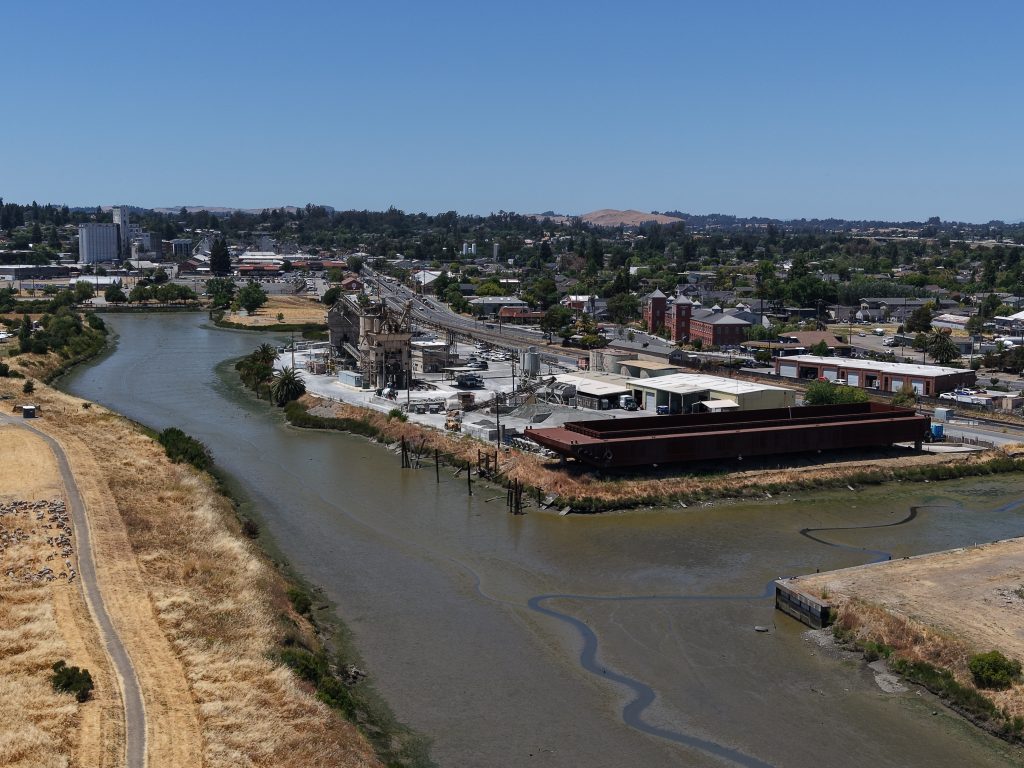
Petaluma pioneer and capitalist John A. McNear and his father-in-law, Michael J. Miller, began constructing the canal and basin in 1890. Dredgers worked nearly three years to excavate thousands of cubic yards of mud that created much of the McNear Peninsula, now home to Steamer Landing Park and the Petaluma River Park.
When completed in March 1893, the basin and canal improved Petaluma’s standing as a manufacturing hub by allowing large shipping vessels to enter the town while keeping a steady water level. Shippers no longer had to consider tidal schedules. The basin consistently measured 20 feet deep and 300 feet wide, connecting to a 600-foot-long canal (averaging 100 feet wide and 15 feet deep) that enabled ships to reach Petaluma regardless of the tide. The ability of large ships to access the port lowered freight costs. Better access to Petaluma encouraged manufacturing businesses to move or establish plants on the river’s east side, including the American-Hawaiian Mahogany Lumber Company in 1906.
The McNear Peninsula
Between 1893 and 1897, J.A. McNear, who claimed ownership of the peninsula, undertook various improvements to the property, including creating a rifle range for Company C of the California National Guard. In September 1901, K.G. Raaf of the California and Hawaiian Sugar Refining Company brought a crew of 250 men to McNear’s peninsula to harvest beets.
A pest house, a quarantine facility for people affected by communicable diseases such as tuberculosis, cholera, smallpox, and typhus, operated on the peninsula until it was abandoned sometime before December 1907, when boys were caught vandalizing some of its structures. By 1915, only a wooden shack remained, which was destroyed by a fire of unknown origin. Investigators suspected it was started by transients seeking shelter.
The peninsula’s transformation continued into the mid-20th century. In 1951, councilmember Leigh Shoemaker proposed developing a civic center on the McNear peninsula, an intriguing concept that, while never realized, sparked the idea for establishing a city park on the property, which has become a reality.

Preserving Petaluma River’s Legacy
The McNear Basin, Canal, and Peninsula represent just one chapter in the Petaluma River’s complex history. To discover more about how this waterway has shaped Petaluma’s development and what is planned for its future from a preservation and accessiblity standpoint, I invite you to attend Saturday’s presentation and/or purchase a copy of The Petaluma River: A Sketch Journal and Brief Historical Overview.
The book is available at Copperfield’s Books, Corrick’s Stationery & Gifts, Riley Street Art Supply, Usher Gallery, Tomales Regional History Center and the Petaluma Historical Library & Museum.
All net proceeds will be donated to the Petaluma River Park and the Friends of the Petaluma River, who are dedicated to preserving this vital natural and historical resource for current and future generations.
 Drees Florist Sign – A Lost 1940s Gem