Recently, the economic health of Petaluma’s historic downtown has been the topic of many city council meetings and newspaper articles, including the Argus Courier’s January 22, 2025, story Petaluma’s downtown improvement district reports declining revenues. So, what better time to share what I learned at the 2024 California Main Street Conference in Eureka last September? Eureka is one of 34 cities in the state that are either accredited or affiliated with the California Main Street program.

It was a small conference with about 70 attendees, representing communities as large as Oceanside (population 170,020) and as small as Ukiah (population of 16,072), along with organizations such as the Small Business Majority. I spent a fair amount of time with Leslie Silver, the executive director of Vacaville’s Downtown Business Improvement District, a California Main Street affiliate.

Leslie explained how renewed interest in the Main Street program partially resulted from work associated with the 2022 Vacaville Downtown Specific Plan and the Downtown Vacaville Revitalization Plan prepared by the Urban Land Institute (ULI) San Francisco in 2024.
The Revitalization Plan addresses some of the issues many cities across the country, including Petaluma, are facing, such as what will spur existing property owners to upgrade their buildings to attract more active uses, including infill residential. [1]
According to the Revitalization Plan, Vacaville’s downtown contains about 30 officially designated historic buildings, which contribute to the city’s architectural and cultural fabric. Preserving these buildings is a key objective of the city. The plan recommends taking advantage of financial incentives and funding opportunities, such as adopting the Mills Act Program —something I suggested to the Petaluma City Council last month.
California Main Street is a unique economic development program established by the National Trust for Historic Preservation (NHTP) more than 40 years ago as part of Main Street America. The program is based on a transformation strategy and implemented through activities in four broad areas of work: economic vitality, design, promotion, and organization.
I first learned of Main Street America in 1992 when I interned for the NTHP at its Washington, DC, headquarters. This life-changing internship taught me how much we can learn about our past through the built environment. I’ve been a member of the NTHP and a historic preservation advocate ever since.

For me, historic preservation goes hand in hand with new urbanism, is a vital economic revitalization tool, and helps mitigate climate change while maintaining a sense of place. Some see historic preservation as having the goal of freezing a place in time, never allowing for change. It’s not—at least not to me and organizations such as the NTHP. It’s understood that buildings evolve through time and that adaptive reuse is a way to preserve our history, resources, and craftsmanship of the past while meeting the needs of today. If this is a topic of interest, I recommend reading Untapped Potential: Strategies for Revitalization.
Because of my interest in historic preservation and economic development, I attended the 2024 California Main Street Conference. I learned that Eureka Main Street is an accredited Main Street America program that began in 1992 as a public-private partnership between the city’s Redevelopment Agency and the Downtown and Old Town merchants. Eureka Main Street operates within the city’s Economic Development Department.

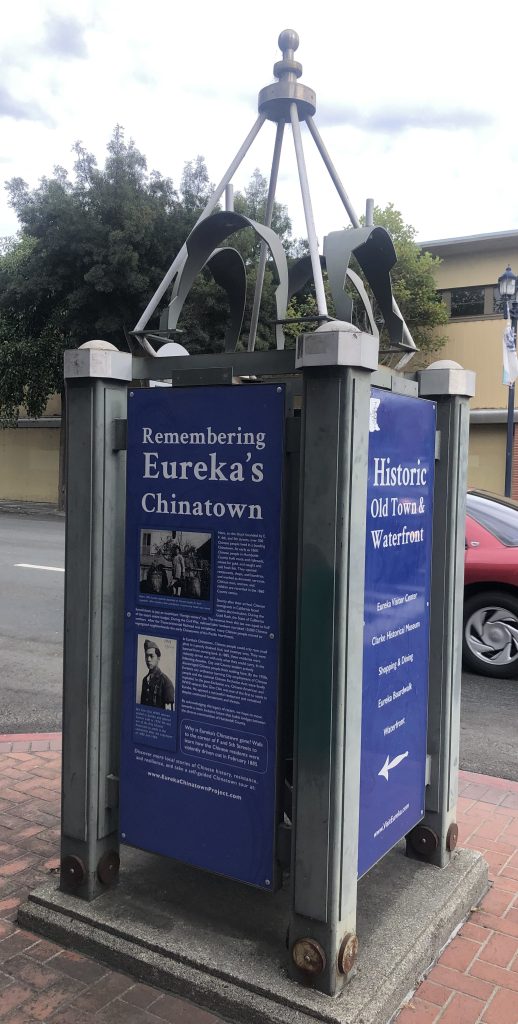
Businesses within the Eureka Main Street District also belong to the Business Improvement District. The Eureka Business Improvement District Association (EBIDA) was formed in 1983 when a majority of businesses in Downtown and Old Town agreed to an annual assessment to fund local projects. BID fees are based on the location, type, and number of employees of the business. The City of Eureka collects the assessments with the annual business license fee.
In addition to gaining an understanding of the relationships that can/do exist between BIDs and the Main Street program, I was excited to see how this Northern California community of 25,800 residents with its nationally registered historic downtown district is supporting economic vitality, honoring inclusivity, celebrating artistic expression, preserving its natural environment, encouraging tourism and local commerce, and promoting quality events.
Highlights of the conference included a mural tour led by Swan Asbury, Eureka’s Economic Development Manager, who discussed in depth the history behind each mural, from the artist’s name to how property owners and community organizations were involved in the planning process to funding for each mural. Many of these murals are included on a virtual map created by the non-profit Ink People Center for the Arts.

During the tour, Swan also shared information about the city’s strategic arts plan, the Economic Development Strategic Plan Update, the Eureka Art Festival, the Cultural Arts District, and Eureka’s partnership with Caltrans.
Eureka is a designated California Cultural Arts District, which makes it eligible to apply for grants from the California Arts Council, a state agency. The designation is used as leverage when seeking other types of financial support.
Caltrans has funded several public art projects in Eureka, such as the Samoa Bridge Murals. Here is a video about the project.
One of the best presentations I heard in Eureka was by Sheri Woo, who introduced conference attendees to the Humboldt Asians and Pacific Islanders in Solidarity (HAPI). Sheri described how her organization advocates preserving an intangible heritage not visible in existing historic structures. Like Petaluma, all buildings associated with Eureka’s early Chinese community are gone. HAPI has partnered with the City of Eureka on several projects, such as the 2021 establishment of Charlie Moon Way, Eureka Chinatown Project interpretive panels, murals, events, and a planned Eureka Chinatown Monument.
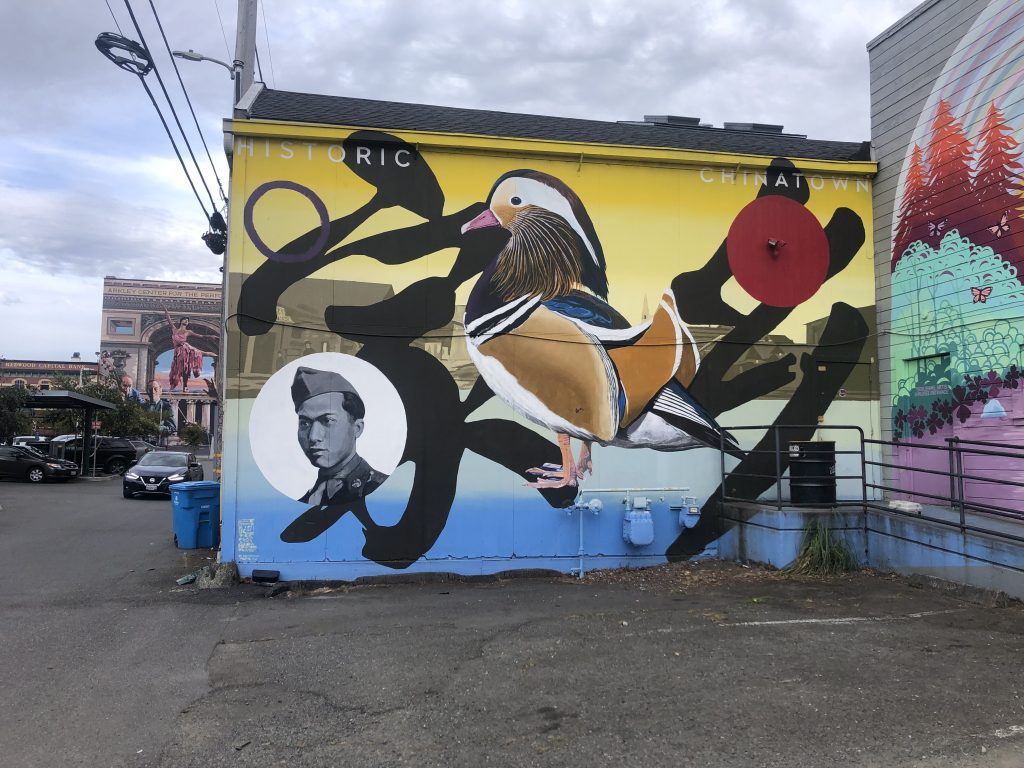
Also, like Petaluma, Eureka’s downtown was listed on the National Register of Historic Places as a district in the early 1990s. Unlike Petaluma, Eureka has achieved Certified Local Government [2] status, participates in the Mills Act Program, and, according to the city’s website, has been actively updating its historic resource surveys and context statements.
I know those working to make Petaluma the best it can be have their hands full and are likely looking to other communities and organizations for ideas, but if Eureka, Vacaville, and Main Street aren’t on their radar, I hope they are now.
My next conference is the California Preservation Foundation’s annual conference in Sacramento in May. Of the anticipated 600 plus participants, I hope to see a few folks from Petaluma there. I suspect Petaluma city staff, council, planning commissioners, and Historic and Cultural Preservation Committee members would be interested in attending the Housing & Heritage conference track sessions. Interested? Go to https://californiapreservation.org/programs/conference/ for more information.
Petaluma is challenged because it does not have a historic preservation advocacy nonprofit, but that may not always be the case. In the meantime, individuals wishing to educate themselves and promote smart development while preserving our history can easily access resources through Main Street America, the California Preservation Foundation, the National Trust for Historic Preservation, and other organizations.
[1] The Urban Land Institute came to Petaluma in 2020. However, their report addressed the downtown within the context of reviving the river as a key urban open space that connects people to nature and each other. To learn more, go to https://sf.uli.org/uli-sf-releases-city-of-petaluma-tap-report/?type=report-tap
[2] The City of Petaluma has been talking about obtaining CLG status since 2006.
 415 Walnut Street, Petaluma – A 1908 Cottage
Thanks for a great read and HOPE coming from this article. Well done and continue LEADING by example and offering more thoughtful commentary moving forward.
Excellent and timely article. Thank you!
Great article, Katherine! So… what will it take to get a historic preservation advocacy nonprofit going here in Petaluma? I’d be happy to help!
Thanks Sue! I’ll keep you and all my subscribers updated on efforts to form a historic preservation advocacy non profit. In the meantime, feel free to share my post far and wide.
Thank you for advocating for our historic downtown Katherine! I think we will have a local non-profit (in the works) with Petaluma Historic Advocates and we all ought to be supporting them!